Cost of Recipe Calculator: A Five-Step Guide
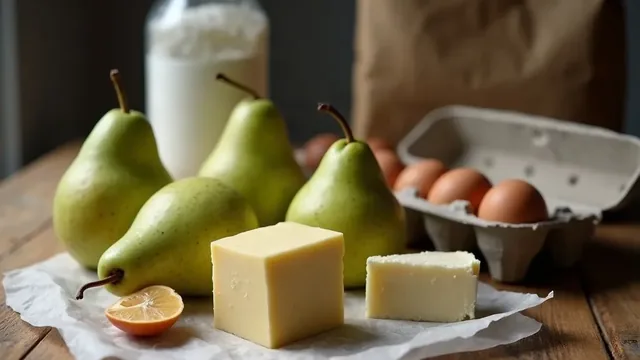
Costing a recipe stalls on units, waste and yield far more than on maths. A cost of recipe calculator is one table that turns each pack price into a line cost, adds the lines, and divides by what the batch makes.
The sample below costs a cardamom pear 8-inch layer cake in three parts: sponge, filling and frosting. It is the sample recipe inside our Batch Recipe Cost file, so every number is one you could type into a sheet.
A recipe cost is only as good as the pack prices you typed in this month.
| Step | What to do | What to watch for |
|---|---|---|
| 1 | One row per ingredient, tagged with its part | Small lines such as lemon and spice still count |
| 2 | Type the pack price and the pack size | Same unit as the recipe, and eggs as a count |
| 3 | Work out the line cost | Amount used ÷ pack amount × pack cost |
| 4 | Price the pack by what you can actually use | Peel, core and shell waste raises the price per gram |
| 5 | Divide the batch by what it makes | A blank yield should give a blank answer, not an error |
Step 1: List one row per ingredient, grouped by part
Write every ingredient the recipe touches on its own row. Tag each row with the part it belongs to. The sample has ten rows in three parts, and the parts cost $4.60 (sponge), $3.60 (filling) and $3.56 (frosting).
Grouping reminds you to cost the frosting, not only the sponge. It also shows you where the money goes.
Step 2: Type each pack price and pack size
Use the price on today's receipt, not the price you remember. In the sample, flour is $4.00 for 1,000 g, butter is $5.00 for 500 g, and eggs are $3.60 for 12.
Keep the pack amount and the amount used in the same unit. A 2 kg bag of flour is 2,000 g. At $8.00 a bag that is $0.004 a gram, so 250 g costs $1.00, the same as the sample line. Cups are a volume, so weigh one cup of your own flour once and write the grams on the sheet. If one amount is in ounces and the other in grams, convert first. NIST lists one ounce as 28.349 52 grams, which is enough to fix any mix-up.
Step 3: Work out the line cost for every row
Divide the amount used by the pack amount, then multiply by the pack cost. For flour that is 250 ÷ 1,000 × $4.00 = $1.00. Do the same on every row and you get the table below.
| Part | Ingredient | Pack cost | Pack amount | Amount used | Line cost |
|---|---|---|---|---|---|
| Sponge | Cake flour | $4.00 | 1,000 g | 250 g | $1.00 |
| Sponge | Sugar | $2.00 | 1,000 g | 200 g | $0.40 |
| Sponge | Eggs | $3.60 | 12 | 4 | $1.20 |
| Sponge | Butter | $5.00 | 500 g | 200 g | $2.00 |
| Filling | Pear | $6.00 | 400 g | 200 g | $3.00 |
| Filling | Cardamom | $8.00 | 40 g | 2 g | $0.40 |
| Filling | Lemon | $2.00 | 200 g | 20 g | $0.20 |
| Frosting | Butter | $5.00 | 500 g | 250 g | $2.50 |
| Frosting | Icing sugar | $3.00 | 1,000 g | 300 g | $0.90 |
| Frosting | Milk | $4.00 | 1,000 ml | 40 ml | $0.16 |
The ten lines add up to $11.76 for the batch. If typing ten formulas by hand sounds like a chore, the Batch Recipe Cost spreadsheet has this table with the sums already in place.
Small lines are rows too. A pinch of salt, a spoon of vanilla and a sheet of parchment all cost something. Weigh your usual amount once. If it is too light for your scale, weigh ten and divide by ten. Boxes, boards and liners belong to the order, so they go in the price step later.
Step 4: Trim the waste before you price the pack
Fruit loses weight on the way to the oven. Say you paid $6.00 for 400 g of pears, then peeled and cored them and weighed 320 g. Your usable price is $6.00 ÷ 320 g = $0.01875 a gram, so 200 g of pear costs $3.75, not $3.00.
One ingredient adds $0.75 to the batch. Weigh your own trimmed fruit once and type the usable weight as the pack amount. The sums after that stay the same.
What a cost of recipe calculator tells you about each part
Sponge is $4.60 of $11.76, about 39 percent. Filling is $3.60, about 31 percent, and frosting is $3.56, about 30 percent. The bigger finding is butter. It appears in the sponge at $2.00 and in the frosting at $2.50, so butter alone is $4.50, more than the pear at $3.00.
Read your own batch the same way. The line that appears in two parts is often the one to watch when prices move. Penn State Extension counts ingredients, labor and packaging as variable costs, and ingredients are the part you can measure today.
Step 5: Divide the batch by what it makes
The sample batch makes two cakes, so the cost per cake is $11.76 ÷ 2 = $5.88. Bake a double batch and the batch cost doubles, but the cost per cake stays at $5.88 as long as the yield doubles too.
For a slice, divide again. Cut the 8-inch cake into 8 slices and $5.88 ÷ 8 = $0.735, about 74 cents. Use your own slice count.
Cupcakes work the same way. Say a batch costs $11.76 and makes 24 cupcakes. Each one costs $11.76 ÷ 24 = $0.49.
Leave the yield blank and a well-built sheet should leave the answer blank too. In our file, a blank yield shows the words Enter yield and no error value.
Scale a batch and catch the mistakes that make a cost too low
To scale, multiply every amount used by the same factor. Double the sample and the batch costs $23.52 and makes four cakes, so the cost per cake is still $5.88. For three cakes, multiply by 1.5. The batch is $17.64 and the cake is $5.88 again.
| Mistake | What it does | Fix |
|---|---|---|
| Counting the yield from the recipe, not from the oven | The recipe says two cakes, but one sinks. $11.76 ÷ 2 looks like $5.88, and the real cost is $11.76 for the one you sell | Divide by what you can actually sell |
| Old pack prices | A price that has gone up makes the whole batch look cheaper than it is | Retype prices from the latest receipt |
| Skipping trim | Pear at $3.00 instead of $3.75 | Weigh the usable amount |
| Mixed units | Grams against ounces gives a wrong line | Convert before you type |
| Leaving out small lines | A $0.40 spice line vanishes | Give every ingredient a row |
Where a recipe calculator stops
A recipe cost covers ingredients only. It has no labor, no box, no board and no margin, so it is not a selling price. For that you need a second step, which is a cost per cake plus your time and a profit.
The Batch Recipe Cost file also has limits. It holds 16 ingredient rows and one batch, and the part names on the dropdown are Sponge, Filling and Frosting. A recipe with more than 16 lines does not fit on one sheet. If your recipe needs more parts than those three, a plain spreadsheet you build yourself will suit you better.
Doing these five steps in a ready-made sheet
Here are the questions that come up before anyone pays for a sheet, answered for this one.
- Will it open in my app? It is an .xlsx file. It opens in Excel. For Google Sheets, upload it to Google Drive and open it with Google Sheets. Google's help page says an Excel file opened from Drive can be edited in Sheets.
- Why not use a free one? A blank spreadsheet or a free online calculator costs nothing, and you build or enter the sums yourself. What $5.99 buys is the work you would otherwise do: the ten line formulas, the part sums, the blank-yield guard, and locked cells so a stray click cannot overwrite a formula. There is no free sample. If you enjoy building sheets, build it from this guide.
- What do I get? One workbook that arrives by email after checkout. The formula cells are locked with no password, and the sample clears when you select the one named range the How to use tab points to.
- What if the steps do not match my app? Every formula in the file is the one shown in this guide, so you can check or rebuild any of them by hand. The first tab is a short How to use page. In Excel, Review then Unprotect Sheet removes the protection if you want to change a formula.
If the table above is the one you would have built anyway, the Batch Recipe Cost spreadsheet saves you the typing.
Frequently asked questions
How do I calculate the cost of a recipe?
Write one row per ingredient. Divide the amount you use by the pack size and multiply by the pack price. Add the rows to get the batch cost, then divide by the number of cakes or servings the batch makes.
What is the formula for costing a recipe?
Line cost = amount used ÷ pack amount × pack cost. Batch cost = the sum of the line costs. Cost per cake = batch cost ÷ cakes from the batch.
How can I estimate the cost of a recipe?
Cost the three biggest lines first, usually butter, fruit or chocolate, and flour. In the sample batch, butter was $4.50 of $11.76. Then add the small lines from your receipts.
Conclusion
A cost of recipe calculator is five moves: one row per ingredient, the pack price and size, the amount used, the trim you throw away, and the yield. The sample batch cost $11.76, or $5.88 a cake, and butter was the biggest single line at $4.50 across two parts. Do the same on your own receipts and you have a recipe cost you can defend. Cost is not a price yet, so add your labor and a margin next.
Sources
- Penn State Extension, Food For Profit: Price and Pricing (2026)last checked October 7, 2026
- National Institute of Standards and Technology, NIST Guide to the SI, Appendix B.8: Factors for Units Listed Alphabeticallylast checked October 7, 2026
- Google, Use both Excel & Sheets: Best practices (n.d.)last checked October 7, 2026